

License plates in Kansas feature distinct colors, graphics, lettering, and numbering that help identify registered vehicles across the state. Standard Kansas plates commonly include recognizable state imagery and a clear format for vehicle identification. Different plate options may use unique backgrounds, symbols, or color combinations based on their purpose or eligibility. Knowing the appearance of Kansas plates can help vehicle owners identify standard, specialty, personalized, military, and other plate types while becoming familiar with the visual features used on Kansas vehicle registrations.
License plates in Kansas can vary in appearance based on the plate category, registration purpose, and selected design. Standard plates provide a consistent look, while specialty and personalized options may feature different artwork, themes, colors, or lettering styles. These visual elements make it easier to distinguish various Kansas plate categories. Reviewing Kansas plate colors and designs can provide useful information about common registration plates, specialty choices, personalized options, and other vehicle identification formats used throughout the state.
Kansas Specialty Plate Designs and Artwork
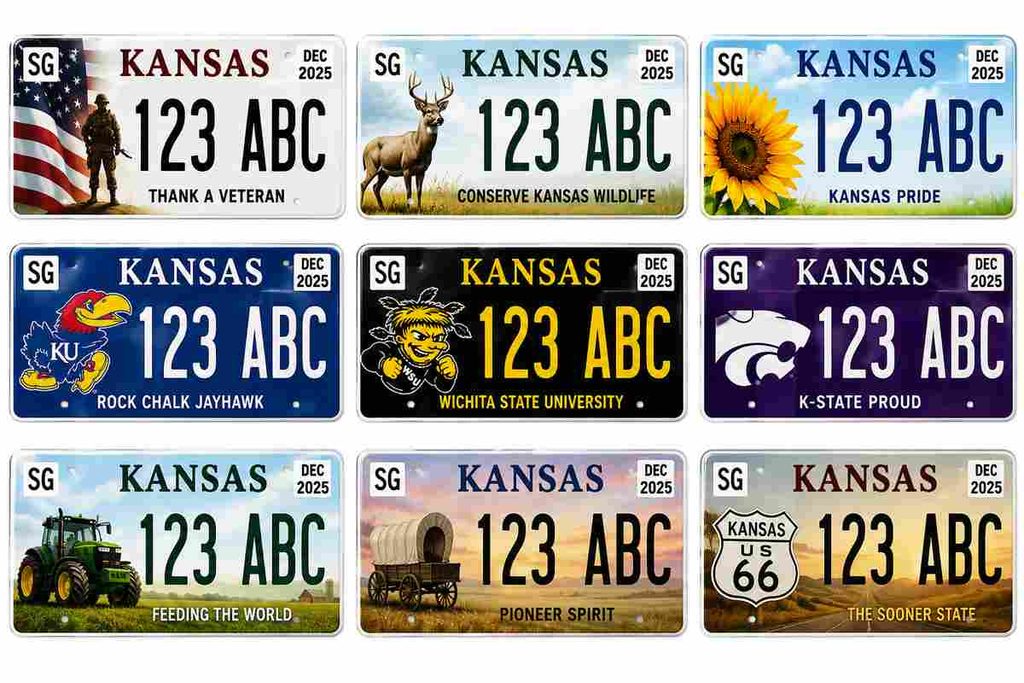
Kansas specialty plate designs give registered vehicles a different visual appearance from the standard Kansas plate. These designs can feature school logos, military symbols, medals, organization names, cause-related graphics, wildlife imagery, and other distinctive artwork. Kansas Department of Revenue lists educational institution, organizational, military, antique, special interest, and other distinctive plate categories. Each category can use its own combination of colors, graphics, lettering, and identifying elements.
Collegiate and Educational Designs
Kansas educational license plates can represent participating colleges and universities through recognizable school branding. The artwork may highlight an institution’s official emblem, name, logo, or school colors.
- Kansas State University: School-related logo, name, and recognizable color scheme.
- University of Kansas: University branding and official visual identity.
- Wichita State University: School name, emblem, and institutional artwork.
- Other institutions: Educational plates can represent additional qualifying Kansas colleges and universities.
- Main design elements: Logos, emblems, school names, lettering, and institutional colors.
Military and Veteran Designs
Plates use artwork connected with Military and veteran service, specific branches, medals, and veteran recognition. Their visual elements help distinguish one military-related plate from another.
- Military branches: Designs can represent branches such as the Army, Air Force, and Coast Guard.
- Medals: Certain plates feature military awards such as the Bronze Star or Purple Heart.
- Veteran identifiers: Some designs identify service periods, military conflicts, or veteran status.
- Military symbols: Branch insignia, emblems, decals, and related graphics can appear on qualifying plates.
- Color schemes: Military-related colors and distinctive artwork can give these plates a recognizable appearance.
Organization and Cause Designs
Organization and cause plates use artwork linked to a participating group, charity, activity, or public-interest cause. Their visual identity can be very different from the standard Kansas plate.
- Charities and organizations: Logos and organization names can identify the sponsoring group.
- Awareness designs: Graphics and symbols can represent a specific cause or public-interest message.
- Wildlife artwork: Some plates use animals, outdoor scenes, or nature-related imagery.
- Sponsor artwork: Participating organizations may have distinctive visual branding on the plate.
- Custom graphics: Colors, illustrations, logos, and lettering can create a unique plate appearance.
- Examples: Kansas Outdoors, Special Olympics, Support the Arts, Sporting Kansas City, Sedgwick County Zoo, Proud Educator, and Topeka Zoo.
Antique, Special Interest and Other Designs
Antique, special interest, and other distinctive Kansas plates can have appearances that differ from standard passenger plates. The artwork and serial presentation depend on the plate category.
- Antique plates: Associated with qualifying older vehicles and their historical character.
- Special Interest plates: Use a collector-style number for qualifying vehicles that retain their original specifications.
- Amateur Radio Operator: Identifies qualifying amateur radio operators through specialized plate lettering.
- Blackout: Uses a darker visual style than many standard plate designs.
- In God We Trust: Features a faith-related inscription as part of the plate artwork.
- Street Rod: Associated with qualifying modified or customized vehicles.
- Support the Troops: Uses military-support imagery and related visual elements.
Kansas License Plate Colors
Kansas License Plate colors are a major part of the current plate appearance. The standard Kansas plate uses a combination of blue, white, and yellow or gold, with dark lettering placed over the graphic background. This color scheme helps separate the registration characters from the surrounding plate artwork while giving the plate a recognizable Kansas identity. Specialty designs can use different combinations based on the specific plate theme or organization. Looking at the colors, placement, and contrast makes it easier to identify the main visual features of a Kansas plate.
Blue, White and Yellow in the Current Design
The current standard plate uses several colors in a blended background rather than a single solid color.
Each area contributes to the overall appearance:
- Blue gradient: Blue appears as a prominent part of the background and creates depth within the plate artwork.
- White transition: White connects different areas of the design and provides a lighter space around portions of the graphic.
- Yellow/gold area: A yellow or gold section adds a warm tone to the color scheme and helps distinguish the plate from designs using a single-color background.
- Dark-gray or black lettering: Registration characters and other lettering use a dark tone that provides strong contrast against lighter background areas.
- Contrast and readability: The combination of darker lettering with lighter sections helps the plate number remain visible while preserving the surrounding artwork.
Why Kansas Uses These Colors
The Kansas plate color scheme gives the standard plate a visual connection to the state through its blue, white, and yellow/gold background. The colors work with the plate’s other graphic elements, including the Kansas outline and Statehouse imagery, to create a unified state-focused appearance. The available design information identifies these colors as part of the plate artwork, but the colors should not be assigned specific official symbolic meanings without a supporting state source. For readers comparing Kansas plate colors, the more useful distinction is the way the colors work together: blue provides a strong background area, white creates contrast, and yellow or gold adds another visual section. This combination contributes to the recognizable Kansas plate appearance.
Colors Used on Specialty Kansas Plates
Specialty Kansas plates can have color schemes that differ from the standard design. Their plate artwork may reflect a particular organization, cause, military affiliation, professional group, institution, or special theme.
Depending on the specific plate, colors can include:
- Red for selected specialty designs
- Blue in designs with state or organization-related artwork
- Black for lettering or darker graphic elements
- Green on selected themed plates
- Gold as an accent or major design color
- Pink on certain specialty designs
- White as a background or contrast area
- Organization-specific colors connected with the sponsoring group or theme
Designs Through the Years
Kansas plate designs have changed considerably since the state began issuing its own plates in 1913. Early plates relied on changing colors, shapes, and the placement of the “KAN” abbreviation to distinguish one year from another. Later designs introduced county codes, reflective backgrounds, wheat and sunflower imagery, Capitol artwork, and the state seal. These changes gradually shifted the plate appearance from simple identification markers to more recognizable state-themed designs. The history also shows how Kansas adjusted its plate artwork when visibility and readability became concerns.
Early Kansas Plate Colors and Designs
Kansas first issued state license plates in 1913. During the early period, the state did not place the year directly on the plate. Instead, Kansas used differences in color, shape, and the position of the “KAN” abbreviation to distinguish plates from different years. The Smithsonian records that year dates were added beginning in 1921, creating a clearer way to identify the registration year. Early Kansas plates could therefore vary in both color and physical arrangement, reflecting the production practices of the period. These early changes established the foundation for later Kansas plate designs, which became more standardized as vehicle registration expanded.
1950s–1970s Kansas Plate Designs
During the middle decades of the 20th century, Kansas license plates incorporated more structured identification features. County codes became part of the registration system, allowing the issuing county to be represented through letters or other plate markings. Designs continued to change in color and format, with state-shaped borders appearing on some plates. By the 1970s, Kansas also used reflective elements to improve visibility. The period included simpler blue and white treatments, along with state-related imagery. Wheat remained an important visual theme in later designs, connecting the plate artwork with a familiar Kansas agricultural image.
1980s–2000s Plate Artwork
The 1980s brought several noticeable changes to Kansas plate appearance. A 1980–81 design used a blue background with a yellow wheat stalk, but readability concerns led to its replacement. The following design used blue characters on a reflective white background with sunflower and wheat imagery. Later designs continued using wheat, sunflower graphics, blue tones, white backgrounds, and gradient treatments. The 1994 design, for example, used a light blue, white, and light yellow gradient with a wheat stalk graphic. By the early 2000s, Kansas introduced a plate featuring the State Capitol surrounded by clouds and a gold-toned lower section with wheat stalks.
2007–2024 State Seal Era
In 2007, Kansas introduced a standard plate featuring the state seal as a major graphic element, with dark blue registration characters on a light blue background and “KANSAS” across the top. This appearance remained in use for many years. Starting in 2018, Kansas began producing plates through digital printing, creating flat plates rather than plates with raised characters. The older embossed standard plates remained valid until the state’s replacement program began. In January 2024, Kansas started replacing standard embossed plates as part of a statewide program. The newer standard background uses the Kansas Statehouse dome within a Kansas-shaped cutout, with a yellow, white, and blue gradient and “To the Stars” wording.
Current Plate vs. Older Plate Designs
The current Kansas plate has a different appearance from many older Kansas plates, with changes in colors, artwork, lettering, background design, and plate production. The modern standard design features the Kansas Statehouse dome within a Kansas-shaped outline, a blue, white, and yellow gradient, and the “To the Stars” slogan. Older Kansas plates used designs featuring wheat, sunflowers, the State Capitol, and the state seal, with many produced using embossed characters.
How Plate Artwork Is Designed for Readability
Kansas license plate artwork has to balance visual design with clear plate readability. The registration number must remain easy to identify from a reasonable distance, so lettering size, spacing, contrast, and background design all matter. A plate can include state symbols, colors, slogans, or other artwork, yet these elements cannot interfere with the characters that identify a vehicle. The plate appearance must keep the number and letters visually distinct from surrounding graphics.
Number and Letter Visibility
The lettering on a Kansas License Plate needs strong separation from the plate background. Clear character shapes and suitable spacing make the registration number easier to recognize.
- Number visibility: Characters should remain clear from different viewing distances.
- Letter contrast: Dark lettering against a light background can make characters easier to distinguish.
- Character spacing: Adequate space between letters and numbers prevents them from appearing merged.
- Background design: Artwork should not overlap or visually compete with the registration characters.
Distance and Nighttime Readability
Plate readability matters when a vehicle is viewed from behind at a distance. Reflective materials can improve nighttime visibility when headlights shine on the plate. A reflective plate can make its lettering and registration number easier to identify in low-light conditions. Kansas plate designs therefore need a balance between decorative artwork and functional visibility.
Reflective Properties and Law-Enforcement Identification
Reflective properties support plate identification during nighttime traffic situations, roadside observation, and vehicle enforcement activities. Artwork, colors, and graphics must leave enough visual separation for the registration number to remain recognizable. Kansas officials have placed attention on readable plate combinations when developing newer designs, showing that plate artwork has a practical purpose beyond appearance. The result is a Kansas plate design where state imagery and visual styling work alongside clear identification features.
Design Changes and the Move to Flat Plates
Kansas License Plate production has changed from traditional embossed plates to digitally printed flat plates. Older embossed plates were made with raised letters and numbers pressed into the metal, giving the registration number a raised appearance. This production method was used on Kansas plates for many years. Modern production uses digital printing, placing the characters and background artwork directly onto the plate surface. This change affects the plate appearance, lettering, and way the registration number is presented.
From Embossed to Digitally Printed Plates
Kansas DOR states that plates issued from August 1, 2018, use digital plate production. With this method, the characters and background are digitally printed rather than physically raised from the metal.
- Embossed plates: Letters and numbers have a raised surface.
- Digitally printed plates: Characters are printed directly onto the plate.
- Flat plates: The finished surface does not have raised registration characters.
- Digital printing: Artwork, lettering, numbers, and background elements can be produced as part of the printed plate design.
Current Production and Readability
The move to flat plates gives Kansas greater flexibility in producing modern plate artwork and clear registration numbers. Digital printing supports a consistent plate appearance across the design, with lettering integrated into the background rather than pressed into the metal. Readability remains a key part of plate production, since the registration number needs clear visual separation from artwork and background elements. The transition from embossed to flat production represents a change in manufacturing rather than a change in the basic purpose of a Kansas License Plate. The plate still identifies the registered vehicle, yet its artwork, lettering, and production method now use a modern printed format.
Frequently Asked Questions
Kansas License Plate designs and colors can vary based on the plate type, purpose, and artwork featured on the plate. The current Kansas plate has a recognizable state-themed design, yet specialty, military, educational, and other distinctive plates can have different colors, symbols, and graphics. These frequently asked questions cover common topics about Kansas plate colors, the current Kansas plate, the “To the Stars” design, Black Kansas Plate.
What is the current Kansas license plate design?
The current Kansas plate features the Kansas Statehouse dome inside a Kansas-shaped outline. Its background uses a yellow, white, and blue gradient, with the words “To the Stars” across the bottom. The design was selected through a public voting process and became the standard plate design used by Kansas.
What colors are on the Kansas license plate?
The primary Kansas plate colors are blue, white, and yellow. The colors appear as part of a gradient background surrounding the Statehouse artwork. The combination gives the plate a distinct appearance while keeping the registration characters visually clear.
What does the Kansas “To the Stars” plate look like?
The Kansas License Plate Design features the Statehouse dome placed inside an outline shaped like Kansas. A blue, white, and yellow background creates the main visual field, and “To the Stars” appears along the bottom. The design references the state motto, “Ad Astra per Aspera.”
What is the Black Kansas plate?
The Black Kansas Plate usually refers to a Kansas plate with a dark or black appearance. Kansas now has an official Blackout license plate, created through legislation effective January 1, 2026. The Blackout plate is a distinctive plate available for qualifying Kansas-registered passenger vehicles and trucks, with a separate annual fee.
Is the Kansas Blackout plate an official plate?
Yes. The Kansas Blackout Plate is an official distinctive license plate. Kansas law authorizes its issuance beginning January 1, 2026, and the Kansas Department of Revenue provides information about eligibility and issuance. The plate carries a $50 Blackout fee in addition to applicable standard registration and plate charges.